A Cancer Survivor Explains How Faith And Community Make Resilience Possible
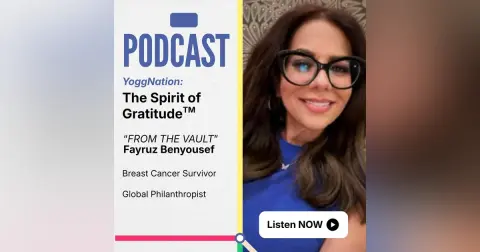
How do you find strength when life takes a turn you never expected? Austin-based philanthropist Fayruz Benyousef shares her journey through Hodgkin’s lymphoma at 16 and a later breast cancer diagnosis. She opens up about the realities of survivorship, the pressure to stay positive, and how faith, supportive communities, and taking life one day at a time helped her navigate uncertainty. Her experiences also shaped her commitment to service, showing how compassion and small acts of kindness...


How do you find strength when life takes a turn you never expected?
Austin-based philanthropist Fayruz Benyousef shares her journey through Hodgkin’s lymphoma at 16 and a later breast cancer diagnosis. She opens up about the realities of survivorship, the pressure to stay positive, and how faith, supportive communities, and taking life one day at a time helped her navigate uncertainty.
Her experiences also shaped her commitment to service, showing how compassion and small acts of kindness can make a meaningful difference in someone’s life.
🧠 What you will learn:
- How to build resilience through illness and uncertainty
- Why cancer survivorship involves more than physical recovery
- How faith, community, and support help during difficult seasons
- How everyday acts of service can create lasting impact
🔑 Key takeaways:
- You can keep moving forward without feeling positive every day
- Your body deserves care, attention, and compassion
- Accepting support is a strength, not a weakness
- Giving back can start with a simple act of kindness
Listen now to Fayruz Benyousef’s story of cancer, resilience, gratitude, and the power of service.
Watch on YouTube or subscribe to YoggNation’s Spirit of Gratitude podcast for more conversations about finding strength and purpose through life’s hardest moments.
00:00 - Facing Mortality And Body Signals
00:33 - Podcast Mission And Guest Introduction
02:05 - Where Resilience Begins At Home
03:38 - Hodgkin’s Lymphoma At Sixteen
05:49 - Doing Hard Things One Step
07:46 - Pay Attention To Your Body
10:12 - Aftereffects Humility And Self Image
12:32 - Philanthropy As Everyday Giving
13:07 - Authenticity And Asking For Help
15:06 - Final Takeaways And Goodbye
Facing Mortality And Body Signals
SPEAKER_00And I literally said to the doctor and my parents, Am I dying? Because I think if I am, somebody should tell me now. I ballooned to 210 pounds because of the steroids I was given. I was the smallest I could be in that time inside. Believe that when adversity comes, not it, because it will, you can get through it, and that help is there. Pay attention to your body. Don't be afraid of your body. Your body is like your best friend in the sense of it's where our soul lives, right? It's the physical being of us, so we gotta take care
Podcast Mission And Guest Introduction
SPEAKER_00of it.
SPEAKER_01Welcome to the OpenAid and the Spirit of Gratitude Podcast. Hello, friends, my name is Joe Kath Cotel, and this podcast explores how diversity shapes success through the lens of gratitude around courage, resilience, appreciation, awareness, and humility. Each week I sit down with high-profile guests who share their wisdom and perspective as we explore personal growth, purpose, and shared value. And hopefully you see a bit of yourself through their storytelling. Join the conversation. I appreciate you tuning in. Welcome to the Yog Nation, the Spirit of Gratitude podcast on the OneTration platform. Hello, friends. My name is Yokesh Patel, and this podcast focuses on bullying, self-awareness, and our inner spirit, inviting high-profile guests to share their experiences on these topics. Prepared to be inspired by my next guest, Ferruz Ben Yusuf, a well-renowned philanthropist based in Austin, Texas, whose life story epitomizes overcoming adversity. From two unfortunate miscarriages to the heartbreaking loss of her father at a young age, and surviving cancer, not once but twice, first at the age of 16, then again three decades later, unbelievable. She certainly has refused to back down. She channels this unstoppable energy, will, and spirit, serving on the boards of Libyan Hearts and the National Domestic Violence Organizations, fighting for those who need a voice. Well, with gratitude, welcome to the podcast, Farus.
SPEAKER_00Thank you,
Where Resilience Begins At Home
SPEAKER_00Yogi. It's a pleasure.
SPEAKER_01From all of the challenges that life has thrown out you thrown at you, how'd you get up in the morning? You know, how did you not give up or just permanently be angry at the world?
SPEAKER_00I just think, you know, I got one shot at this life. I'm super duper grateful for it. I think my inner being just appreciates learning and living. And uh yeah, I'm not, like you said, interested in backing down. I'm here.
SPEAKER_01Where did this resiliency come from?
SPEAKER_00Probably watching my parents. You know, they came to this country from Libya excited for a new uh learning opportunity to pursue their higher degrees. And I think just watching them as I got older, still a child, dealing with what became a tyrannical political regime, still being optimistic, still being faithful, still like a can-do spirit. And then my dad's leukemia that struck when he was 35 and I was eight years old. That really showed me a lot about resilience and how he went through it with such poise and like just such a beautiful heart, despite all of the challenges that he was undergoing, not only medically and the pain he endured, but knowing that the in the background that we didn't have any family here. We had no one. It was us against the world. Everybody was back in Europe or North Africa. So I think just observing that did a lot in terms of how it built my own resiliency.
SPEAKER_01So
Hodgkin’s Lymphoma At Sixteen
SPEAKER_01now I understand you again losing your father at that young age. Tell me, tell us about the experiences battling cancer.
SPEAKER_00So what happened is I was working at Bob's Big Boy in Harrisburg, Pennsylvania, and I was so excited. It was my first big girl kind of job outside of babysitting or something like that. And I was getting ready to go to work one day, and I noticed that my collarbone, which you can see here, normally sticks out on this left side, no longer did. This one was, but this one wasn't. And so it just looked like this puffiness. There was no pain, yogi. There was no, you know, I was eager, happy, excited. I had a really um exciting summer ahead. But when I noticed this swelling, um, my mom immediately, when I went and showed her, I said, What do you think this is? It doesn't hurt. She's she just went white because my dad's leukemia eight years prior began with a swelling in the neck, night sweats, all these similar kinds of things. And I didn't have the night sweats, but just this prominent deal. So I think just um I was 16 and wanted to conquer the world. Like I can specifically remember what a downer being told you had Hodgkin's lymphoma. Uh, that was a whole ordeal with my parents being told before me. And I remember them walking back into the ER room where I was that day and my mom crying. And I literally said to the doctor and my parents, Am I dying? Because I think if I am, somebody should tell me now.
SPEAKER_01At the age of 16.
SPEAKER_00At the age of 16. Those were I kid you not, those were my exact words. But in that moment, I was just like, What is happening? And when they told me that I had to go through a biopsy, that they thought based on my blood work and the scans, there could be a cancer or tumor, I was like, you know. I denial. Like, no, I don't have time for that. And in fact, 30 years later, when I was diagnosed with almost stage three breast cancer, uh, I kind of had the same reaction. Like, I don't have time for that.
SPEAKER_01Unbelievable. Was there some sort of inner spirit that told you to move on, to take things one step at
Doing Hard Things One Step
SPEAKER_01a time?
SPEAKER_00Because absolutely. I think about this a lot because life is hard and we don't know what we're gonna get dealt. You know, I've had my fair share, but the more I live, I know a lot of people go through so much. They're going, you're probably listening now, you might be going through something really troubling and hard. And I tell myself this, yogi, you can do hard things. You have done hard things because I have. And I think about in the moment, it feels so awful. But one day at a time, one scan at a time, one procedure at a time, and that's the way that in part I've been able to get through it. But I do also have a really strong connection to uh the divine creator, if you will. I grew up Muslim, and um for us it's like a direct line to God, uh, no intermediary. So I believe that there is a higher power that's there for us and that we can turn to, and that really has helped me get through a lot of these difficult times. So I feel like being in community and having even if it's just one person, say it could be, I literally remember saying with one of my I had five surgeries total with my breast cancer in 2019 and between late 2018 and 19. And I remember saying to one of the like the anesthesia nurse, I said, please say a prayer before you begin. I don't I said, I don't whatever you believe, just please say a prayer. And said I looked at her and I said, I believe in you. And she was so sweet, and she's like, Oh, I absolutely will, and and we got you, you know. So that energy begets energy. It's like if we can put out good energy, if I finding that if I can put out good energy even in my toughest, most weakest of moments, it's good.
Pay Attention To Your Body
SPEAKER_00It's good. So, like I said, I had this growth here, which probably I should have noticed sooner. I think the caveat I'm gonna share on this for all of us is pay attention to your body, pay attention to how you feel. Um, it's really hard nowadays. I 16 back then in 1988, I didn't have the internet. But nowadays, the minute a symptom pops up, what do we all do? Google, what could this be? So pay attention to your body, don't be afraid of your body. Your body is like your best friend in the sense of it's where our soul lives, right? It's the physical being of us, so we gotta take care of it in all the ways. And Yogi, I wish I would have learned this earlier in my life, even though I did um have Hodgkins at 16. I think I just, in many ways, to tell you the truth, because of the traumatic experience of having it and going through a massive surgery that removed my spleen. I was in the pediatric unit of Hershey Medical Center in Pennsylvania with little babies that had had open heart surgery. I mean, there was no one that looked like me or was my age, like an adolescent. So this all happened in a 90-day window. I noticed this, yes, I noticed this in June. Surgery in July, radiation in August, 30 days, done. Lost most of my hair because they radiated from above my ears to right under my breastbone. And I remember telling my mom as my hair was falling out in the shower, if I don't have hair, because I had hair like Diana Ross back then, I'm not going to school. My hair is my identity. Luckily, it was so long yogi that it covered like everything that was lost from here down. Let me just say. Now, even though the actual diagnosis to end of treatment was 90 days, what was excruciating and still remains that way is the after-effects that evolve that nobody really tells you about, or they didn't back then. So, like as we sit here and talk, I not only have nerve pain going down my left side, but in my entire chest wall and part of my back, I can feel the nerve pain.
SPEAKER_01Favorite
Aftereffects Humility And Self Image
SPEAKER_01was you mentioned that uh I now look at cancer as something I'm glad happened to me. How do you mean?
SPEAKER_00Yeah, that's uh probably weird to hear, right? Like, why wouldn't one be glad for that? Um let me explain. When I look back on it, it gives you a whole new set of perspective of what people endure. And mine was cancer, but there's people with all kinds of other challenges. So I would say I've gained so much compassion. I was always a compassionate person, it's just how I am, but it's a newfound version of that compassion uh going through it. I feel like it also helped me pause because it was just go, go, go, whether I was a young adolescent or certainly a woman who was 46 and had a child at, you know, starting high school at that time, taking care of my mom who had been diagnosed five months before me with metastatic breast cancer. I I just think it gave me so much newfound perspective, humility. You know, I lost every hair in my body, eyelashes, eyebrows, I became bald. It really humbles you. I ballooned to 210 pounds because of the steroids I was given. I just felt, in some ways, to be honest, like I was the smallest I could be in that time. Inside. Because the me that I knew to be me, at least the shell outside, no longer looked like that. I didn't look anything like me. I literally was unrecognizable. And yet, when I would go to infusions for my chemotherapy, I would paint my eyebrows on. I became really good at it, let me tell you. I would wear the red or the hot pink lipstick, I would find the cutest outfit in the closet that would fit. And I did have to buy new clothes, so I did allow myself that luxury. And I would put a smile on, and those nurses would embrace me. And it was what gave me hope. Just like, you know what? I can still try my best to look my best. And people commented on it. They'd be like, You have the cutest outfit today. Look at your makeup looks great today, you know.
SPEAKER_01And
Philanthropy As Everyday Giving
SPEAKER_01is that how you became a philanthropist?
SPEAKER_00So when I think of being a philanthropist, it's really being someone who cares about people, sees the opportunity to help, whether it is the National Domestic Violence hotline, and serve on that board and not only donate financially, but be a resource with my skills and my knowledge, open doors. Um, but I want to say being a philanthropist is even the act of giving a smile. But I think our human spirits are resources, they are the best resources that we could give each other.
Authenticity And Asking For Help
SPEAKER_01What would you tell your younger self?
SPEAKER_00Boy, I would tell her that younger version of Fabrews a lot of things, one of which would be do not be afraid to be who you really are. And what I mean by that is I was told to assimilate. Try to just fit in because we don't want people to know you're from Libya because of the repercussions of what that might mean. So think of what that does to a young person.
SPEAKER_01It helps you lose some of your identity.
SPEAKER_00Absolutely. And so what I would tell young people today is you know what? You are you. God created you to be you. But I would say just be your authentic self. The older that I get, the less I care if someone is going to make a decision about whether they like me or not because of my background or my faith practice. It doesn't matter. Young people and people as a whole need to know there are people who will listen. You can get help if someone is not treating you right. Just like at the hotline, you know, there are sources, whether you are feeling so low, you may think about taking your life, or whether someone's hurting you. Like, don't be afraid to ask for help. That is another huge lesson that I learned through the adversity is I never wanted to ask for help before. Now I'm very different. When I need to ask for help, I ask for help. And I'm grateful for it.
SPEAKER_01Is that the main theme that you serving on the board of the uh National Violence Organization?
SPEAKER_00Ask for help. Yeah. Help is on the line. That's actually our tagline.
SPEAKER_01Fairruz, thank you kindly for your time. I look forward to connecting with you again soon, hopefully when I make my trip to Austin and we can uh go from there.
SPEAKER_00Yes, thank you so much. It's an honor.
SPEAKER_01Absolutely. I'll leave the final word to you. Any parting thoughts?
Final Takeaways And Goodbye
SPEAKER_00Be generous with a smile, with a helping hand, and believe that when adversity comes, not if, because it will, but you can get through it and that help is there. Help is on the line, as the hotline says, there will be people in your network, even they might be a stranger, but uh don't hesitate to ask for help when you need it.
SPEAKER_01Perfect way to end the segment. Thank you, Ferris.
SPEAKER_00Thank you, Yogi.