The Secret to Performing When the Pressure Is On
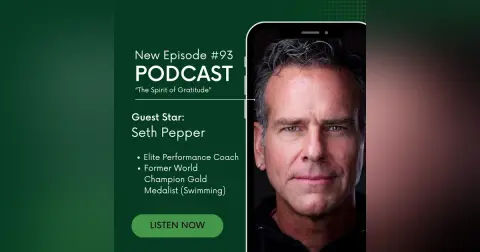
Pressure often shows up when something really matters to you. Elite performance coach Seth Pepper joins us to break down what happens in the mind and body when the stakes get high. We explore the difference between pressure and stress, why discomfort can fuel growth, and how Seth’s own journey toward the Olympics shaped his approach to resilience and mental toughness. The conversation gets practical with tools for managing nervousness, reducing resistance, staying present, and performing ...


Pressure often shows up when something really matters to you.
Elite performance coach Seth Pepper joins us to break down what happens in the mind and body when the stakes get high. We explore the difference between pressure and stress, why discomfort can fuel growth, and how Seth’s own journey toward the Olympics shaped his approach to resilience and mental toughness.
The conversation gets practical with tools for managing nervousness, reducing resistance, staying present, and performing without being consumed by the outcome.
🧠 What you will learn:
- The difference between pressure and stress
- How resistance can impact performance
- Why reframing nervousness can change your mindset
- Practical tools to stay calm and focused under pressure
🔑 Key takeaways:
- Pressure often means something meaningful is at stake
- Discomfort can be part of growth
- Focus on the process instead of the outcome
- Small shifts in posture, gratitude, and perspective can change your state
Listen now to Seth Pepper on performance psychology, resilience, mental toughness, and handling pressure.
Watch on YouTube or subscribe to YoggNation’s Spirit of Gratitude podcast for more conversations that turn pressure into opportunities for growth.
00:00 - Pressure Means You Care
03:36 - Pressure Versus Stress In The Body
05:12 - Follow Your Blisters To Bliss
06:50 - Starting Swimming At Fourteen
13:45 - Ability Minus Resistance Explained
15:32 - The Nothing To Lose Breakthrough
20:37 - Parenting Without Adding More Pressure
23:14 - Turn Nerves Into Excitement
27:10 - Gratitude Through Posture And Smile
32:06 - The Eff It Switch And Faith
Pressure Means You Care
SPEAKER_02Pressure, as far as we try to frame it, is a positive stress or stress response is when you get into the survival mode of fight, flight, freeze. Pressure just means you care. So if you don't care, you're not gonna feel any pressure. Your optimal performance equals your ability minus resistance. So you feel nervous. Okay. So you feel the nerves whenever you care about something and it hasn't happened. Yes. And that's where your mind enters and tries to figure out is this gonna be good? Am I gonna be a hunter or am I gonna be hunted? The only way you feel alive is when there's something hanging in the balance. I mean, that's just for everyone. And so to get into the flow state to feel your bliss, you have to go through the blister.
SPEAKER_00Welcome to the Yoga Nation, the Spirit of Gratitude Podcast on the One Tegration platform. Hello, friends. My name is Yogesh Patel, and this podcast explores the themes of building self-awareness and the power of our inner spirit, including the silent battles we all face. Join me every week as I invite high-profile guests as we explore how adversity shapes us, how gratitude lifts us, and how we can all uncover the inner strength that we all have within ourselves. Join the conversation. I appreciate you listening in.
SPEAKER_01And as a central theme of this podcast is how adversity shapes success through the lens of gratitude, it's impossible to ignore one of adversity's most common ingredients, pressure. And few people understand pressure from as many angles as my next guest, Seth Pepper, one of the most sought-after elite performance coaches, trusted by athletes across all four major sports, including golf, tennis, F1, NASCAR, and the NCAA, as well as leaders at Netflix and Marvel Studios. And how did he earn his credibility? He was an NCAA national champion, a world championship medalist, an American record holder, and a Hall of Fame athlete in swimming. And what makes Seth's perspective so valuable goes well beyond sports citizens. His work gets into the human side of performance, the anxiety, the identity, the mental toughness, the burnout, and those self-limiting beliefs that can quietly keep us from reaching our own potential. And at the heart of it, Seth simply wants to help people get out of their own way to understand what exactly happens internally when pressure shows up and how to perform without being consumed by the outcome. And I think that's something we can all learn from today. And with gratitude, it is my honor to welcome you to the podcast, Seth.
SPEAKER_02I'm grateful to be here.
SPEAKER_01Absolutely. Well, curious to find out why is pressure difficult for so many people to handle?
SPEAKER_02I would just say simply it's uncomfortable. So a lot of time when we feel discomfort, we label it and we think it's something that there's something wrong. And so it's changing the relationship to pressure, I think, is key. That anytime there's an opportunity, there's gonna be pressure. And so we feel that throughout our life. You know, a little kid will feel it if they're gonna go have an important conversation, right? And they'll start to think of what's gonna happen, you know. Um, maybe turning in homework. Am I gonna get good grades or am I gonna, you know, the other version of that? Um, all the way through life, asking someone out on a date. Um, you know, yeah, that's pressure. That is a big one. I remember that many times of like, oh, how's this gonna go? And uh, you know, and then going into other high-level performance uh environments where one putt can equal a half a million dollars, you know. So it's one of those things.
SPEAKER_01Is pressure the same thing as stress in your in your uh viewpoint?
Pressure Versus Stress In The Body
SPEAKER_02I would say pressure uh uh as far as we try to frame it is a positive stress or stress response is when you get into the survival mode of fight, flight, freeze. So a lot of times if you have a certain level of pressure, it's really healthy and it engages you. There's there's something that creates a uh, you know, like a tension that grabs your attention. But if you go too far, then it goes over to the dark side of pressure where it becomes stress, where you feel overwhelmed. Right. And that attention actually goes to the negative where it's hard to focus and your energy level goes down and you may feel heavy, irritable, those sort of things. Um, well, I think pressure is necessary. Uh, you know, in the Where is it necessary? I think it's necessary in the creation, right from the very beginning, because pressure just means you care. So if you don't care, you're not gonna feel any pressure. So a lot of times people will say, Well, if I just cared less, then maybe I this won't be as uncomfortable. Well, that's not gonna work because you're not gonna really fully be engaged, you're not gonna be at your best of your ability. So, in order, you know, the ultimate is to be in what they call the flow state, right? The flow, the zone, being present in the moment. And you need pressure, otherwise, you won't have any sense of urgency. So that relationship to pressure is is key. You can't not care and get into the optimal state. So there's
Follow Your Blisters To Bliss
SPEAKER_02a popular phrase you might remember um, follow your bliss.
SPEAKER_01Yes.
SPEAKER_02Yeah. And that's kind of was really adopted and taken to the extreme in the self-help sort of field, because people would say, Oh, well, I'm just gonna follow my bliss and I'm just gonna bliss out.
SPEAKER_01Right.
SPEAKER_02That's an easy, you know, way of interpreting it to your advantage, that it always has to feel good. What Joseph Campbell, the mythology expert, um, really meant was follow your blisters. That's why, you know, I've been told that he was frustrated that the the version that kind of almost is a bit of a sellout, that's the one that got picked up. The one that he really meant was you got to feel the pressure, you got to feel the blisters. And that will drop. Yeah. And and so I equate it to surfing a wave. Okay. And so the wave has to be big enough, you know, because the big wave surfers, they get into the flow state on a regular because out of necessity. And so if the wave isn't big enough, it's not going to create the stimulus the, you know, for you to feel pressure. And if you can feel the pressure and do it anyways, as long as you're capable of surfing in the first place, right, then you will feel your bliss, but you first feel the blister, which is the pressure, the uncomfortable part of it.
SPEAKER_01Interesting. That's a different perspective because I always known Joseph Campbell's mythology to be that of the hero's journey.
SPEAKER_02Yeah, yeah. Right. That's a big part of it as well.
SPEAKER_01Yeah. And
Starting Swimming At Fourteen
SPEAKER_01then going back to your swimming days, you didn't learn how to swim until the age of 14. And yet, tell me the story about you telling your swimming coach, I want to go to the Olympics. I mean, that had to be pretty bold of you at the time to say that. What went through your mind and how did you choose swimming as that sport to get you to that uh championship level caliber?
SPEAKER_02For me, I had fallen in love with the Olympic feeling, right? There's the Olympic dream. And I came from a family where no one was an athlete. They were artists, you know, so teachers and artists. Yeah. So sports was not something we talked about. Kind of different. Very different. Yeah. Um, and so once I decided I want to go to the Olympics, I was encouraged to go after what I was interested in. So it was just basically studying the Olympics. So I started with the idea of the Olympics, but I didn't have a sport. And so I watched the the next Olympics to decide what sport am I going to go after. And there was a girl that had won a gold medal, and I was kind of raised to trust some sort of unseen force, if you will, you know, Joseph Campbell. Yep. The force, uh, the life force. So out of this, these sort of synchronicity or timing, there was a girl who won the gold medal. The announcer asked, if there's someone out there that wants to do this, what would you recommend? And I remember feeling like they were speaking to me because whatever she said, I was going to do. And she said, I went through a YMCA program. So that's the coach. I went down to the local Y. I didn't even know we had one. And so I went down there and I walked in and said, I want to go to the Olympics. Can you help me? And I think being 14 and being so specific that was out of the norm. And he smiled. And then he said, Okay, well, uh, do you know how to swim? I said, No, not at all. That's when he started laughing. Um, but you know, good nature. Yeah, and it everyone laughs when I told you know that part of it because it was it was funny because it was very unusual. Um, but the reason why I tell that part is that I had found through my dad's books, because I always was surrounded by books of self-improvement.
SPEAKER_01Yeah.
SPEAKER_02And so it had started this curiosity because it was always about thinking, speaking, and doing. So being able to create your destiny, go after, you know, whatever it is that you can dream. And so when I went to the coach, I wasn't looking for his approval, I was just sharing this is this is my focus.
SPEAKER_01Right.
SPEAKER_02And had he laughed to the point where he was kicking me out, I just would have found someone else. I would have kept going. Okay. Because I had already had the idea, the vision locked in. And eventually someone it would have connected. So thankfully, it was the first one where he laughed, but he allowed me to go and train, or actually, not even train, I had to learn how to swim. So I was with 10-year-olds and eight-year-olds, like tiny little kids. Um, and so that was very humbling. Right. But at the same time, I came from the perspective of learning. So I didn't have a history. I I didn't even know that I was failing or that I was losing because I didn't have anything to compare it to. So for me, it was all learning.
SPEAKER_01And that's an important lesson. Sorry to interrupt, but you know, with with kids these days and even adults, right? Perhaps not knowing what their north north star is, they can at least just take that first step. Absolutely. Yeah.
SPEAKER_02I mean, I think if you go in with the idea that it needs to work um the first time, I just don't know, like it's interesting because I'll have uh athletes, let's say, or teams, look at a scientist or an inventor or even uh an entrepreneur and say, okay, if the first time they had a beta test and they had to get it right, or otherwise they were a failure, you would be terrible at all three of those. Right. So why can't an athlete go into this and go, I'm gonna fail all the time? You know, kind of like you know, creating the light bulb. You're gonna fail thousands of times, but you have to have a clear vision of what you think this could turn into. Right. So for me, the Olympics were the light bulb.
SPEAKER_01Interesting. And you were so close. Yeah. Alternative, that must have been devastating. And how did you overcome that? Because I think that's central to this, how adversity shaped success. You had that adversity, it molded you to become the performance elite athlete coach that you are now.
SPEAKER_02Yeah. I think, you know, to be effective at what I do now is more about losing than it is winning. You know, a lot of great athletes don't that's unheard of. They don't really end up being great coaches because maybe they got all this success or they got the big ones. And so to be really, I think a great leader or a great coach or a great mentor, there's a lot of humility involved. And so you have to be relatable. And I think it just makes me a lot more relatable because I didn't get it. Right. And it's kind of this this uh sort of um I I guess I guess you'd say like a sore that never heals. It creates this curiosity, this need where I'm always looking for, you know, what could have changed things, and then I just apply it to giving it to people that I'm working with now.
SPEAKER_01It's fascinating. I mean, what you just mentioned just uh sparks back memories of just the the will to compete and just the will to have fun. And I'll get to that momentarily. And kind of when you as you coach these elite athletes, what are some of the most common mental blockers when working with them? And I say mental just because again, what I'm trying to do is trying to bridge the gap between you know your wisdom and perspective on an athlete versus not gonna say common, but perhaps the everyday kid struggling with school or whatever their endeavor is.
SPEAKER_02No, it's a great question. And uh to your point, it doesn't matter if you're an athlete, if you're you know, you mentioned some of the other people, an actor, uh film director, you know, a scientist, yeah, you know, whenever you feel the pressure and there's a risk there of failing, you know, there there's this, you know, we talked about the flow, right?
Ability Minus Resistance Explained
SPEAKER_02So your optimal state when you're at your best is um it's a it's just a simple formula. I would say that equals your ability minus resistance or noise. That's the math I'm getting at. Okay, that's what you were looking for. Okay, I can do that math. I'll just tease it. Please continue. Yeah, yeah.
SPEAKER_01Can you repeat that one more time?
SPEAKER_02Your optimal performance equals your ability minus resistance. Okay. Or you you you fill in the blanks a version of noise or distraction.
SPEAKER_01Resistance mentally.
SPEAKER_02Yes. Okay. So basically, when someone asks me, what do you do? Give me a quick, you know, uh phrase. I say, I just help people get out of their own way. Right. You said that in in in the intro. And this resistance, this noise is you, it's your identity, it's your ego, right? Some might call it the monkey mind, you know. And what I find to be the biggest inhibitor of performance is, you know, it could be your identity, it could be expectations, it's kind of judgment, shame, all those sort of things. And so what's interesting is that I am hyper focused on optimal performance across the board with anyone and everyone, whether it's an individual or an organization. And what the the weird juxtapositioning of the whole thing is that I have found that people are at their best when they're at their worst. Okay. Yeah, I'm gonna get you on this. Okay. So they have a phrase on the PGA tour, LPGA tour, and I have a few clips on it, you know, that I'll show people. Beware
The Nothing To Lose Breakthrough
SPEAKER_02of the sick or injured player. Okay. So what do they mean? They mean when someone's sick or they're injured, not injured to the point where they can't play, right? But it's something that's gonna annoy them, you know, it's gonna be something that aches, but they can still physically do it. What's happening is that they will be so distracted, they will they have a chance of that resistance dropping or completely being removed because of that distraction. And they will play out of their minds, unexplainable. And so that's something that you don't necessarily want to, you don't want to have to get sick or injured in order to play well, but to understand, well, how do I do this naturally? And so a lot of times what you'll see is spikes in performance where someone, the first round, they're terrible, right? So bad that they just go, I almost want to give up. And then they come the next day and they're amazing. It's like two night and day performances. Why? The first day they basically dug a hole, a big ditch, and then the rest of the performance is gonna be well, I guess I have nothing to lose. I'm just gonna go play. So this part has been removed because there's no more expectation.
SPEAKER_01And that's one of your coaching mindsets, just eff it.
SPEAKER_02Yeah, yeah, yeah, exactly. So tell me about tell us about that. Well, that happened, you know, just in the moment. I had had two, you know, you you could say like two seasons ahead where I was the next guy. I had been second in the nation. And both times they were. Second in the nation, in the nation to the Olympic gold medalist. Yeah, yeah. So it was, it was, it was good. Yeah, it was doing well, especially after I just learned how to swim six years earlier, right? So it wasn't that long ago. But I had a I had a really amazing coach who was a world record holder, and so he had done something that no one had ever done before. So he was really great at not just coaching me, but also getting my mindset, my perspective. And he could see the greatness in me that I couldn't see. Now, he would say things to me, he was an artist also. Rick Damont, he's an incredible person, incredible coach. And he would say to me the first time, you know, why are you asking for permission? It's like, what does he mean? Yeah, I'm doing pretty well. This this guy was on TV and I'm almost beating him. And then the next time it happened, he said, Why are you apologizing for your greatness? Stuff like that. He was still being supportive, you know, sure, but he would always have that like zinger in there to like, you know, make me kind of question what was going. And and what I'd started to realize is that he could see more that I couldn't see. And a good coach can do that. I I will say this to people. I will say, I know when I'm in the presence of greatness. And I'm saying that not as a compliment, but as an as an observation.
SPEAKER_01Is that a feeling?
SPEAKER_02Yeah, it's uh it's like a because you have to be able to see it in yourself, right? Right. So you know when you're in the presence because you're a very grateful person, you're interested in human potential. So you probably know when you're in front of someone or you're like, wow, this this person, there's something different about them.
SPEAKER_01My wife doesn't agree though. Just kidding.
SPEAKER_02I'm sorry, yeah. No, this is great. Um, so so I'll say that to someone. Yeah, yeah. And there are many, many times where I can see something that maybe they can't see. They can see part of it, but they can't see all of it. So I think that's the advantages of working with someone that can actually draw that out in you. And so that's what my coach was seeing.
SPEAKER_01And it's also applicable to a parent teaching or raising their child or children.
SPEAKER_02As long as there's a catch on that, because I grew up what you know, since I was older.
SPEAKER_01Right.
SPEAKER_02I w and I didn't have a history. I watched a number of my friends not want to be there. So there is the parent coach that's living vicariously through their their child.
SPEAKER_01Okay.
SPEAKER_02So that's kind of a dangerous like pressure where they're pushing it, but they're pushing it in it from the outside rather than the inside. So that you want the athlete to be intrinsically motivated from the inside rather than extrinsically from the outside.
SPEAKER_01So then when do parents know when encouragement becomes that stress, not pressure, as you mentioned earlier.
SPEAKER_02Well, I think that's a tough one because I'm a parent, and I don't, you know, I think all parents' intention is good in in general. Yes. I think the education of understanding how you can help your child to be at their best, that's something where they may not know exactly how to do it or how to ask for it, or that it's even a thing. And so here I am coaching people, and I'll coach parents and you know, uh groups, and I have to work on it myself. My
Parenting Without Adding More Pressure
SPEAKER_02daughter, she just started high school and you know, she's in basketball. And, you know, the thing I coach parents on is when the child gets in the car, don't ask them how it went. Now that sounds really strange, but the child is trying to figure it out. Right. They have this conversation, whether they know it or not, they are having a conversation in their head because they don't they want to do well. How many people enjoy not doing well? Zero. They know when they're doing well and they're not doing well. They know when they're trying to figure out the mathematical problem that's in front of them.
SPEAKER_01Yeah.
SPEAKER_02And so when a parent gets involved, they mean well, yeah, but the idea is like they they all of a sudden will say, Well, how'd you do? And now the child is having this conversation with themselves, it's being interrupted, and now they have to answer that too, which can compound their confusion. So I think that what my parents did without knowing it is they gave me space to figure it out. Right. They just supported me as a human being, not as a human doing. You know, it's kind of a phrase that I use. As is so it wasn't about Seth the swimmer, it was about Seth. And so my dad believed in me unconditionally, and he had no idea what my results were. He had no idea what you know my best time was. But I like that. That space, that in the world.
SPEAKER_01He didn't want to find out intentionally, or just the fact that that would put more pressure on you.
SPEAKER_02I think it just gave it since sports weren't really uh you know a thing, it was more like a hobby. Yeah, he's just like, Oh, you're having fun. And ironically, you know, I'll work with these high-profile athletes, and they'll have a father and they'll have a mother, you know, show up at performances. And when the mother's there, usually the athlete performs a lot better than the father. And the reason being is because men want to fix things, and so they'll feel like, okay, dad's gonna have some sort of critique. I better be, you know, ready to go. Whereas a mother is more interested in the feelings and hey, did you have fun today? And then they play better because it's not about the end result, it's less pressure. Yeah, it's their natural sort of like, okay, just go have a good time. Yeah. Yeah, which is the greatest uh performance enhancer.
SPEAKER_01So then what do you then coach athletes that again could be applicable to the parent, not necessarily as a parent coach, but just as a parent raising their children to be good people?
SPEAKER_02I would say have a healthy relationship with the pressure, like we talked about.
Turn Nerves Into Excitement
SPEAKER_02So everything's on the line, you feel uncomfortable. So a really simple one is just changing the words. So you feel nervous, right? Okay, so you feel the nerves whenever you care about something and it hasn't happened. Yes. Right. And that's where your mind enters and tries to figure out is this gonna be good? Am I gonna be a hunter or am I gonna be hunted? Stress. All right. So pressure, stress. Right. And so if they have a healthy relationship with this discomfort and it's framed correctly, they go from nervous. So when you're nervous, you your body starts to the vitals start to pick up. You breathe faster, your heart rate picks up, your temperature goes up, and then you project into the future. And then when you're excited, the same things happen. So it's the same experience. It's just one, like with nervous, you could just sit there and go, Oh, I hope things go well. You're almost like in a victim state versus I'm excited. And you got to kind of coach yourself into, okay, I'm I started with this uncomfortable nerve thing. And then you ask the, I always say, ask the question. Because you your brain is going to have to answer if you ask a question. Why am I excited? So that's the thing that I'm trying to get them to move into the discomfort and turn it into excitement. It's the same experience on the inside. So that's a big one. So with my children.
SPEAKER_01Wouldn't they have known that or nurtured that throughout their years of perfecting their craft?
SPEAKER_02I think at all levels they reach a certain point where they're still going to have those nerves. They're still going to get to the point where, okay, this is it. And then your mind does weird things. So helping someone, you know, golf tournaments take four days usually. Right. Right. And so let's say the golfer reaches a point where they're in the lead, they break the course records the first day, the second day goes just as well. And the third day, all of a sudden they're going, oh, because because you have the fear of failure at the beginning, right? The first half. Now you have fear of success. Oh my gosh, I might mess this up. There's something really at risk because now I'm actually in position to realize my dreams of winning this.
SPEAKER_01And that happens to a lot of plays in the NFL, college, you name it. Across the board. Yeah.
SPEAKER_02That's why for me, the value is that I can look them in the eyes and say, I've been there. Right. This is this is okay. You know, and so I'll go, I just call it taking the teeth out of the bear, right? The bear is kind of like the monster under your bed.
SPEAKER_01Yeah.
SPEAKER_02So you just turn the light on and it disappears. You try to avoid it, the monster gets bigger. So what we try to do is we go, okay, what are you feeling? I'm feeling really nervous right now, or I'm feeling really uncomfortable. That's totally okay. Makes sense. That's something, you know, that's important to you. And then I'll go, okay, what are your thoughts? Well, I'm gonna mess this up. Totally understandable. Your mind's, you know, working through the two options. I'm gonna do really well or I'm going to die out there. And then there's usually a catastrophe attached to it, which is I will mess this up. And it doesn't make any sense. It's not because this isn't about rational, this is about mental and emotional. Now everyone in my life's gonna leave me. It doesn't make any sense. They even know that okay, people aren't gonna leave me over a golf score or a result. But just being able to talk through it, you've turned the light on the in the room, and now they no longer have to resist it, and it's just gone away.
SPEAKER_01And it's that awareness.
SPEAKER_02Exactly.
SPEAKER_01Yeah.
SPEAKER_02And and so even at the highest level, those little tiny sort of encouragements of just being able to just be okay in the discomfort dissolves the effect.
SPEAKER_01Do you
Gratitude Through Posture And Smile
SPEAKER_01sprinkle in gratitude as part of the way that you encourage your athletes?
SPEAKER_02Absolutely. Gratitude is the optimal state. You know, I'm, you know, we've talked a little bit about golf. So Rory is one of the top golfers. And before he won the US Open, the one thing that he worked on for the months leading up to it was his body language. Okay. So your body language, your physiology will affect your psychology.
SPEAKER_01Sure.
SPEAKER_02So just by sitting up and putting your shoulders back and your chest out, it changes your confidence. It actually lowers the stress because now you're expanding, you're getting bigger, right? And so that's what he worked on. And then also what he worked on was his eye line being above the crowd. Because when your eye line is above the crowd, the angles are expanding. You're in a state of gratitude. When you're looking down, usually they're converging and you're going more inward. And then you can your posture will follow you. And then all of a sudden, you start to stress out more.
SPEAKER_01That is so amazing.
SPEAKER_02I never Isn't it interesting? It's the simplest things. That's what fascinates me about this. It's not about knowing it, it's about doing it when you're really uncomfortable, yeah, and trusting it and doing it over and over again. So I kind of sit in the simple of it and I protect the simple well, you make it simple. Yeah, and I keep it simple.
SPEAKER_01Yeah, yeah. This will work. And speaking of one world-class athlete like Rory McElroy, I want to give another example of uh Carlos Alcaraz. Yeah. So, I mean, I love tennis. Yep. And I'm not sure if you know this uh this gentleman. I just happened to catch it on uh LinkedIn. His name is Dr. Jim Afromo, um, sports and performance psychology. And he what his LinkedIn post the other day read, Carlos Alcaraz recently returned to competition after 139 days away, and said something every athlete and coach should study. Well, Carlos said, he didn't say that he missed winning or lifting trophies. He said, I missed the nerves, the pressure, the tense and difficult moments, and the challenges of figuring out how to handle them. That's aligned with what you just mentioned.
SPEAKER_02It it's it's one of those things that the only way you feel alive is when there's something hanging in the balance. I mean, that's just for everyone. Right. And so to get into the flow state to feel your bliss, you have to go through the blister. So I have to encourage people to get uncomfortable.
SPEAKER_01And I'm getting goosebumps around because I remember when Carlos lost to Ben Shelton in the US Open, he was all smiles afterwards. Yeah. He put everything out there. Yeah. And I think his quote was I put everything out there, I'm smiling. Exactly. And he lost in a five.
SPEAKER_02He's a great example because if you notice, even if he loses a point, if it's a good point that he can appreciate, he will smile and appreciate just the greatness of that moment. And he actually has gone, you know, I have a lot of clips that I show people on the power of your smile. So we go back to body language. He intentionally smiles because when you smile, it puts you in a state where it's a it's grateful. You're you're expanding. And so there's a lot of different athletes that uh Steph Curry will do this. He'll go through a slump and then, you know, of just shooting a free throw. And he'll go to the free throw line and he'll do intentional smiling. So he has a isn't that to intimidate the other competitors?
SPEAKER_01No.
SPEAKER_02I mean, I I don't think that's in his nature. I could see some of the other players doing it. Yeah. But to him, he actually spoke to it afterwards and he said, No, your attitude manifests results. So attitude is something you can control. You can control attitude through your physiology. So he's smiling to change his attitude. Attitude shifts everything, it shifts your perspective. And also after he makes that free throw, he celebrates like crazy. Like he does these huge pumpers, and it's almost like he just won the game, but it was a simple free throw. All he's doing is creating just a little bit of interruption, and it's again you being in a state of gratitude, going back to being a little kid again.
SPEAKER_01Seth, I wish I had more time. Seriously, I mean citizens, and I like to call the listeners of the Yog Nation the citizens of Yoge Nation, but I just please take heed heart in what uh Seth just mentioned. I mean, for me, what struck the most was the example of Wurr McElroy, what he saw above the uh the spectators, and then just that difference between stress and pressure. I mean, to me, that is what I found most valuable getting goosebumps. Seth, I'll give you the final word. Is there anything that I missed in this episode recording that you'd like to share to the audience?
SPEAKER_02Well,
The Eff It Switch And Faith
SPEAKER_02we brought up the effort switch. Yes. And so you and you talked earlier, that is the book that I'm putting together, writing. And so when I finally did win, what happened? Because my coach had said those few things to me. Um, the final opportunity I had, the final year, I was behind the start, and all of a sudden I said, F this, F these people, I'm F and taking it. And that sounds aggressive, but actually, what it was, it was peaceful. It was a state, it would going back to Star Wars and Joseph Campbell, when he says to Luke Skywalker, trust the force. Yes, he's saying, trust the life force that flows through you. So it's an egoist state. That noise, that resistance drops and it's not about you, it happens through you. So that's the optimal state. That's what we're all searching for in performance and in life. And so the eff it switch is just a a place of being able to say, I don't care what's going on in the world, like I'm not following everybody else's world, you know, judgment, perceived judgment of me. And then I'm going to break the rules on the inside and just allow myself to go out there and do it.
SPEAKER_01Well, the F could the F word could be the four-letter vernacular, or it could stand for faith.
SPEAKER_02I love that even more. I I would adopt that because I really feel like what I do is almost like a preacher of performance. It's it's it's one of those things where I feel like I'm just trying to help people to get to this state where it's not about them.
SPEAKER_01Right.
SPEAKER_02You know, and it is described for someone of faith, it's described as a religious experience. It was for me where you just I don't remember it. It was the best race of my entire life, and it had nothing to do with me. It just sort of happened through me. Right. And that's a religious spiritual state. Or if someone's not from that background, I'll just say, you know, you get in your car and you drive to the store without thinking.
SPEAKER_01Yeah. So you're in your zone.
SPEAKER_02You're in the zone and you're allowing the car to drive itself.
SPEAKER_01Yeah. Are there any other themes you explore in the book?
SPEAKER_02Well, it yes, the effort switch is just kind of maybe more eye-catching, just and also I don't really cuss. So it's one of those weird things to everybody wants to talk about the eff it switch. And I'm like, I okay, I will. It grabs people's attention. But I think for me, it's it's really allowing people to go after their dreams. So I was talking crazy when I said I want to go to the Olympics. But then when I almost I was the next guy to go to the Olympics, right? I missed it by that.
SPEAKER_0192 at Barcelona, right? Yeah. Okay.
SPEAKER_02Yeah. My hero that I'd put on the wall had handed me the national championship trophy when I won. And then he came out of retirement and he handed me the ultimate defeat. He took the spot on the Olympic team I would have taken. So I got as close as you could get. But I would say that's that's getting my dreams. And it is continued because I help others to get their dream through this sort of curiosity of what could I have done differently. Right. So that's what I would say to people is think it, speak it, do it. And it's a real thing. This is not some sort of imaginary, wild thing that's just written in spiritual books or self help books. Like I've seen this over and over, and I could just tell you case examples of people. So it's it's a real tangible thing.
SPEAKER_01And it's leading with the heart.
SPEAKER_02Yes.
SPEAKER_01Yeah. Seth, thank you kindly for joining us on the Yog Nation Spread of Gratitude Podcast. God bless. God bless. Thank you.